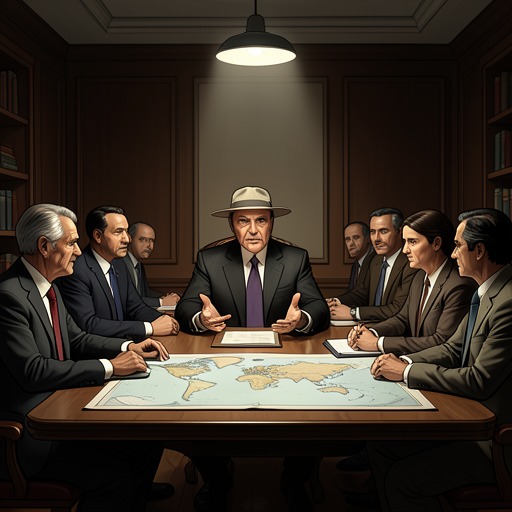
George C. Marshall
American PrometheusGeorge C. Marshall’s significance in this account lies in a revealing combination: he entered the atomic-policy debate as a senior military authority, yet in the decisive discussion about the Soviet Union he argued for an opening that went beyond simple suspicion. His intervention at the Interim Committee meeting of May 31, 1945, brought military authority into contact with J. Robert Oppenheimer’s case for cautious cooperation; later, Oppenheimer’s stated confidence in Marshall made him an example of the personal trust on which Oppenheimer’s political judgment sometimes rested.
Role at the Interim Committee
Marshall attended the May 31 meeting of the Interim Committee alongside Secretary of War Henry L. Stimson, General Leslie Groves, James F. Byrnes, and other government officials. Oppenheimer, Enrico Fermi, Arthur Compton, and Ernest Lawrence were present as scientific consultants. The composition mattered: scientists who had spent years building the bomb were invited into a discussion of atomic policy, but the meeting was not convened to decide whether the weapon should be used against Japan. Stimson controlled the agenda, and the account presents that military decision as effectively settled in advance, with authority resting in the White House.
Stimson nevertheless described the bomb as more than a new weapon: it could alter humanity’s relation to the universe, become a danger that consumed its makers, or contribute to global peace. That framing opened a discussion of the postwar consequences of atomic power, even as the scientists’ formal influence over military use remained limited. Marshall’s contribution emerged within that tension between immediate wartime authority and the larger question of what kind of international order the bomb would create.
The Soviet question and the test
When Stimson raised the possibility of postwar self-restraint, international oversight, and inspection, Marshall cautioned that an inspection system might not be effective. Russia, he said, was the paramount concern. His warning registered a central security problem: a proposal for international control could not be assessed apart from the United States’ uncertainty about Soviet intentions.
Oppenheimer did not let that uncertainty settle the matter. He urged tentative discussions with the Russians and argued that their attitude should not be prejudged. He proposed describing the national effort and expressing hope for cooperation without disclosing the engineering details of production. In the account, Marshall’s response is striking because it goes beyond merely hearing the proposal. He defended the Russians against a history of accusations and counteraccusations, many of which, he said, had proved unfounded. He also argued that there was no reason to fear that, if informed about the project, the Russians would pass the information to Japan. Most strikingly, he raised the possibility of inviting two prominent Russian scientists to witness the test.
That suggestion met resistance from Byrnes, President Harry S. Truman’s representative at the meeting. Byrnes feared that allowing Soviet observers would lead Joseph Stalin to demand entry into the atomic project. The difference was not simply over how much technical information to reveal: Marshall entertained a gesture of scientific participation, while Byrnes treated the same opening as a potential claim to the project itself. The meeting ended without resolving that conflict. The account notes that the committee’s conclusion combined a drive to stay ahead in atomic production with an aspiration to improve relations with Russia, leaving cooperation and competition uneasily joined.
Oppenheimer’s confidence in Marshall
Marshall also mattered to Oppenheimer as a trusted person, not only as a voice in a policy meeting. In Senate testimony about the proposed May-Johnson legislation, Oppenheimer acknowledged that he had endorsed the bill’s general philosophy before reading its details. Asked about allowing military officers to sit on the proposed commission, he said that the issue was not the uniform a person wore but the person’s character, and named Marshall as an administrator in whom he could have exceptional confidence. The testimony does not establish that Marshall shared Oppenheimer’s position on the bill. It does show that Oppenheimer used Marshall as his example of why military status alone did not disqualify someone from responsible administration.
Oppenheimer’s confidence in Marshall helps clarify his approach to institutional power. He could argue for international discussion and freer scientific exchange while still trusting particular figures within the existing government and military establishment. His brother Frank Oppenheimer wanted to take the case for international controls directly to the public; Robert believed change had to be pursued from within the Washington scene. Marshall’s name in the Senate testimony gives that preference a concrete point of reference, although the evidence does not show that Marshall was involved in Oppenheimer’s strategy or that he supported international control as Oppenheimer conceived it.
Public standing and changing circles
In June 1947, Marshall appeared in a different role: at Oppenheimer’s Harvard graduation, he unveiled the Truman Administration’s plan for European economic recovery. By then Oppenheimer was a prominent member of the American establishment, holding major scientific and advisory positions and mixing with influential public figures. The account identifies Marshall as a friend, placing their association within that expanding public world.
A later recollection, relayed by Haakon Chevalier, gives the friendship a more complicated edge. Chevalier asked Phil Morrison what had become of Oppenheimer; Morrison said that they hardly saw each other and no longer spoke the same language. He recalled Oppenheimer referring repeatedly to “George” before Morrison interrupted to ask who he meant. To Morrison, Marshall remained General Marshall, or the secretary of state, rather than “George.” Morrison offered the anecdote as evidence that Oppenheimer had changed and moved into a different circle. It records Morrison’s perception of Oppenheimer’s new social ease, not a private account of Marshall’s own relationship with him.
Taken together, these episodes give Marshall a defined but bounded place in the narrative. At the 1945 meeting, he could acknowledge security concerns while resisting an automatic presumption of Soviet misconduct; in Oppenheimer’s testimony, he represented a trusted administrator whose judgment mattered more than his uniform; and in the postwar recollection, his first name became a small sign of Oppenheimer’s changed standing. The account does not make Marshall the architect of Oppenheimer’s policies. Instead, it shows how his authority and personal example helped mark the narrow, unstable space between military power, scientific openness, and political trust.